
When Ancient Echoes First Called Out to Me
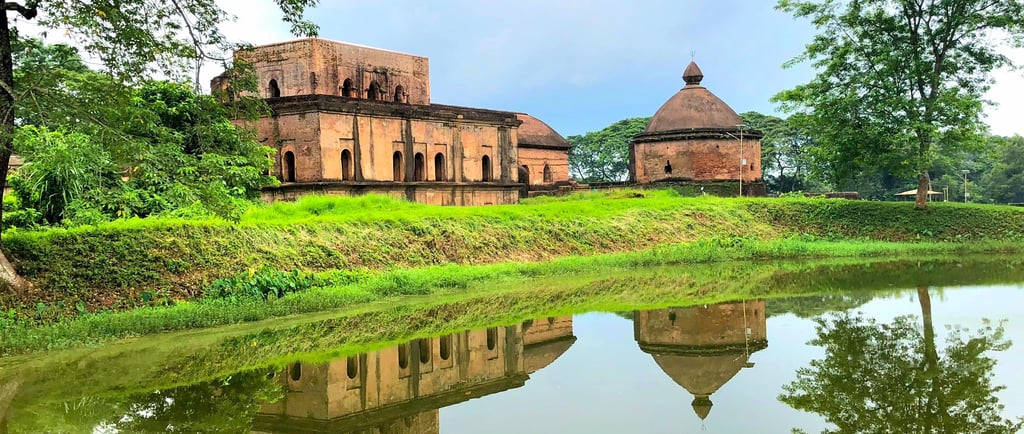
A recollection of my first visit to the historic Talatal Ghar in Sibsagar, Assam, when I was 5; old enough to wonder, too young to understand!
The biggest crime one can do is deprive oneself from enjoying history like it is some prized gossip by projecting into it the morals, obligations, and ethics of the modern day. It is so much more interesting when observed with a sense of objectivity. At best one can do is learn from their mistakes, otherwise they are now stories of dead people, and as much as we would like to establish some relation with them, should they be ressurected, it is highly likely that they would laugh at our faces and show dissapointment at being called their kin. That being said, as much as one loves to imagine the past to be some exotic, strange, or fantastical place like it is some setup of a fantasy novel, the more one reads about it in the surviving documents, literature, inscriptions, etc., the more one cannot help but think how similar we have all been as humans, with similar emotions, with similar propensity to hustle and dupe others, with similar levels of promiscuity even if different forms of civility and etiquettes existed compared to now, only for us to find a way to find loopholes to submit ourselves to those instincts!
My first brush with history as a thought was perhaps when I visited Sibsagar to attend my cousin's puberty ceremony. I was five years old. It was January and school was closed for the winter. Soon I would be attending class 1 once school reopened after the holidays. One can imagine my excitement as a child getting together with all my uncles, aunts, and most importantly, my cousins, and that too in the setting of a wedding. To top up my excitement, the fact that we were in an ONGC colony for the ceremony, as my uncle, the father of the girl who was the subject of the celebrations, worked there, was an added layer of jubilation to my young mind. Living in a village surrounded by stretches of paddy fields as far as the eye could see, I could only think of the boasting I could do to my friends once I returned. The idea of living in a colony with every road being paved and lined with street lights, and multi-storeyed buildings with elevators being as common as bamboo thickets in our village, were few of the things that made my young rustic mind feel like being transported to a foreign land.
It was during that trip that our parents decided to take me and all the cousins who were around my age to see the monuments of the latter part of the Ahom rule. One of the monuments that actually tickled my imagination as a child of 5 was the Talatal Ghar which felt like a labyrinth in its own right. We were warned beforehand, perhaps to avoid running away from the eyeshot of the elders, that people often got lost in the convoluted corridors of the monument. We were also told that the massive building had underground tunnels which were now closed for visitors, and thieves and spirits lurked there. As much as the palace made me wonder at its grandness, an inexplicable fear aroused in my heart. There was something mysterious about the place, like secrets hiding under every layer of air, and to my juvenile mind that could not articulate those nuances, I was afraid of getting lost and encountering something undesirable. My mind was quick to imagine how kings and queens must have lived there, what they must have eaten, and how that place might have smelled back in the day, or if I lived there in one of my previous lives.
The warnings of our elders had no effect on us, and we began to play hide and seek. Much like any group of kids our age, we were an uncontrollable lot, and just like our elders had warned, my fear must have conjured the Murphy's law of the propensity of things going awry if it could, I realised at one point I was all alone. I took a staircase that led to a landing, and realised I wasn't accompanied by any of my cousins. I called out to them and got a reply, but there was no way I could trace them back through their voices. Following my voice, one of my cousins came out of a door and I could see him standing at a landing adjacent to where I stood. However, to my dismay the two points were not directly connected. It was like seeing someone through a magical separation without the reward of tangibility. I was relieved to see him, but there was no way I could run back to him. Trying to trace back my way would only mean further getting lost. Much to my relief, in no time, one of my uncles appeared behind my cousin and asked me to stand where I was, and in a little while he reached me and accompanied me back. He made sure to make an example of my getting lost as a cautionary tale of obeying the elders, a rule we followed during the remainder of the trip.
Getting lost, even if it was scary, it was overpowered by my wondering at the complexity with which those buildings were built by our ancestors. As I began to grow older, I would often revisit that memory and with age, the wonder only grew. Even today when I visit the monument I marvel at it, and I come back with more questions than I approach it. If only someone kept a diary about those times like they did in other times, I would think, or better still, if by some magic I could meet someone from those times. My best bet to satiate my hunger for learning about those times were the Buranjis, the Ahom chronicles, and some other writings by Muslim and some western travellers. It always amazes and disappoints me in equal measures. I am always amazed by their brutality and strange rituals that would perhaps make a modern person raise their eyes to their foreheads. Subsequently, my disappointment arises because the more I read, the more I am reminded of their ordinariness. They were no different than we are today if looked at from the abstractness of emotions. It is only the disparity of time that gives them an exotic quality, or rather we choose to glorify them as such. One more reason of my disappointment is that not enough contemporaneous records survive, at least not as much as I would have liked it to. I can only imagine how much the queens, princes, the slaves, the servants, and more importantly the peasants, the village busybodies would have had to say to us, things that would have perhaps only reemphasised how similar we were underneath the garb of modesty, the fear of the law, the frivolity of our greed, and the insecurity of our jealousies.
Contact
E-mail: author@kaushikdowarah.in
Follow
Connect with Me