
The manuscript of the stories she lost
And, as with habit, the fragrance of the mango blossoms, which has permeated the air that afternoon, combines with the scent of the pomelo blossoms creating an allure, and causes her heart to flutter in anticipation of spring and the Bihu festival like it did when she was a young girl.
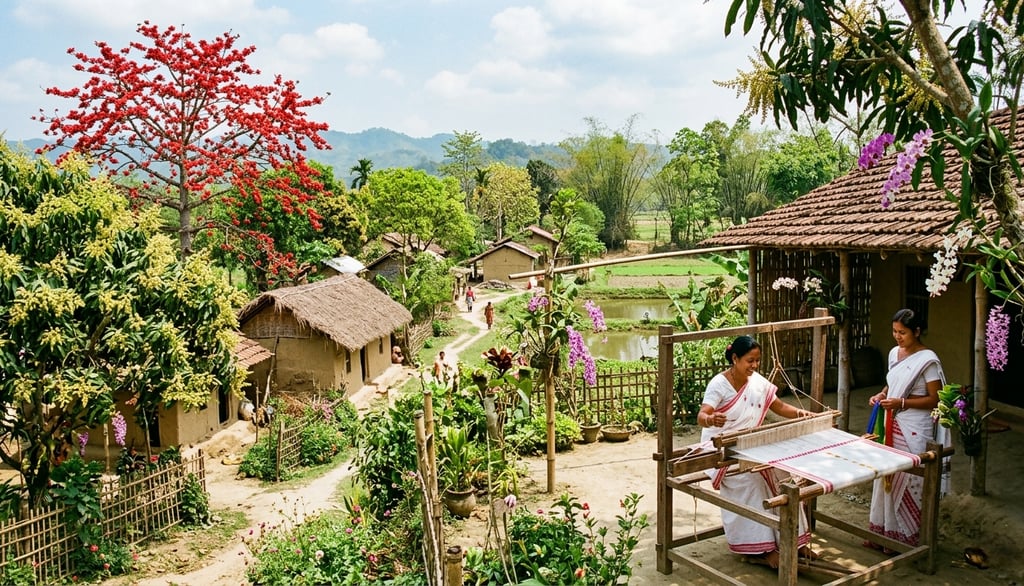
She breathes in the earthy scent of the bamboo leaves as she strolls down the lane lined with bamboo thickets on one side and a bamboo fence that forms the edge of someone's farm on the other. Soon the mud lane would be impassable once the spring rains arrive with no name of taking a break, relentlessly passing love letters from the sky to the earth. The mango has blossomed early this year and in plentiful quantities. However, such abundance causes her heart to tremble, as there is an old saying that an unusual abundance of mango blossoms is a sign of heavy rains during the monsoon. Regardless, at her age, she hardly has anything to fear, having lived through her fair share of pain and bliss; yet fear is now merely an old habit that has never left her. And, as with habit, the fragrance of the mango blossoms, which has permeated the air that afternoon, combines with the scent of the pomelo blossoms creating an allure, and causes her heart to flutter in anticipation of spring and the Bihu festival like it did when was a young girl. The essence of the festival only endures in her memories now, and yet she eagerly awaits it each year, either out of habit or the hope that the festival will somehow be restored to its former splendour. Despite the constant, excited anticipation, she always finds herself taking a deep breath at the end of the festival and regretfully going over her old memories again, like eating a sweet rice-cake to mask a bitter aftertaste. The only thing that now makes the annual event more enjoyable is the build-up, the waiting for the festival to come and the spring to blossom to its fullest. Perhaps that is what makes certain things beautiful; the hope of it all. Or perhaps, that is also reflective of the evolution of our bond with certain people who were once dearer than life itself, people who are vibrant only in our memories, while in reality they are far from how we anticipate our next meeting with them to be.
Now she sits on the verandah of her house after the walk. On the tea table in front of her is a handwritten manuscript. Construction of a highway is underway only a few hundred metres away, resulting in a dense layer of dust in the atmosphere that becomes apparent as the sun begins to traverse the western sky. She has had visitors who inquired if that was untimely fog, to which she had chuckled and wondered if that was what has become of everything; a faux replacement for everything that was once natural, just like the spring festival! The sound of the loom's treadles striking the crossbeam or the shuttle passing through the warp and the endless chatter of women making preparations which was once an unmissable precursor of the months leading up to the festival is now being replaced by the sound of heavy objects colliding with concrete. In a similar vein, the ancient traditions are being kept alive through the rituals, pomp, and joy and most notably through capitalization of every facet of the festival; yet having tasted the real affair, she can discern how everything appears to be just a namesake, an imposter of the real thing. That is perhaps the order of the world we live in; we barter our ties with nature for our idea of development!
For some time, she has been contemplating the singular most valuable gift she could give to her daughter, in addition to the life, upbringing, and substance she has provided. This was the moment when the concept for the manuscript was conceived. She has documented everything she knows, and most importantly her memories. She has painstakingly attempted to make a nuanced depiction of the world in which she was raised, a world that is now only in her recollections and may eventually fade as she aged. There couldn't have been a better time to write about it than now, before the dust that surrounded her penetrated her skin and clouded her mind. She would live on in the stories, along with her former world, its people, and even their dialect. She is conscious of the extent of linguistic change. In her people's attempt to speak the “standard” tongue, many of their local terms, expressions, and even tonalities are slowly fading away and are often mocked as rustic rather than being celebrated for their distinctiveness. Even cuisines have changed, drawing heavily from foreign cultures, and the commmonplace familiar cuisines from her youth are now sold in specific restaurants as “ethnic” delicacies.
She isn't averse to change. Identities evolve and change, and they can never be a dictate petrified in stone. In fact, the quest of certain sections of society to identify as some rigid entity has caused so much confusion and conflict that she sees around her. Hundreds and even thousands of years old ideas are being brought up and passed like rumours to validate those identities, when hardly anyone of them has read the ancient writings, or spared even a second to think and wonder. Fixated on the past and about things they do not know, there is very little that is being done to preserve the things they know, the culture they embody. She wonders where the stories of her people are, where the libraries that promote the reading and research of those stories are! Thus, she has committed herself to writing down her story in the hopes that it will endure, if not exactly as she intended, in some way, through conversations, stories, and anecdotes, much like the sun's rays, after travelling astronomical distances, take the shape of the mangoes she enjoys eating in the summer.
Contact
E-mail: author@kaushikdowarah.in
Follow
Connect with Me